By: Benedicta Naa Odarkor Ablateye, Communications Officer, ACEPA
In Africa, parliaments serve as the foundation of democratic governance. They make laws and ensure governments remain accountable to the people. However, a crucial question remains: Are African legislatures genuinely serving the citizens they represent? The answer is not a simple yes or no. It is a work in progress, and that depends enormously on several critical factors. Chief among these are data‑driven decision‑making, inclusive representation, and a parliament’s willingness to engage meaningfully with its people to ensure accountability.
The Accountability Gap
The issue of accountability in governance transcends the mere act of holding elections every few years. It encompasses the ongoing responsibility of elected representatives to monitor the use of public resources, assess the effectiveness of national policies, and ensure that the needs of the most vulnerable populations are addressed. However, many parliaments in Africa face significant challenges in fulfilling this role. Parliamentary research departments often lack sufficient resources, and members of parliament frequently lack access to reliable, timely data on their constituencies. Moreover, civil society organizations, which should facilitate communication between citizens and parliament, are sometimes excluded from crucial policy discussions. Additionally, women and marginalized groups, who disproportionately bear the brunt of poor governance, tend to be underrepresented in legislative processes.
Consequently, these challenges are not merely abstract institutional concerns; they have tangible consequences for governance and development. Budgets may fail to reflect community priorities, policies often fall short of their intended objectives, and citizens can become increasingly disconnected from the institutions that are meant to represent and serve them. These are not abstract problems. They have real consequences: budgets that do not reflect community needs, policies that miss their targets, and citizens who feel disconnected from the institutions that are supposed to serve them.
Data as a Foundation for Accountability
One of the most powerful tools for closing the accountability gap is data. When MPs can access, understand, and use evidence, whether it is national census data, SDG progress reports, or constituency-level statistics, they are better positioned to ask the right questions, demand accountability from the executive, and advocate for their constituents.
This insight was at the core of ACEPA’s Data for Accountability Project (DAP), which is the first initiative specifically designed to strengthen the use of statistics in parliamentary oversight and representation in Ghana. Launched in 2019, DAP was implemented in partnership with the Ghana Statistical Service (GSS), the International Network for Advancing Science and Policy (INASP), and On Think Tanks (OTT) Consulting.
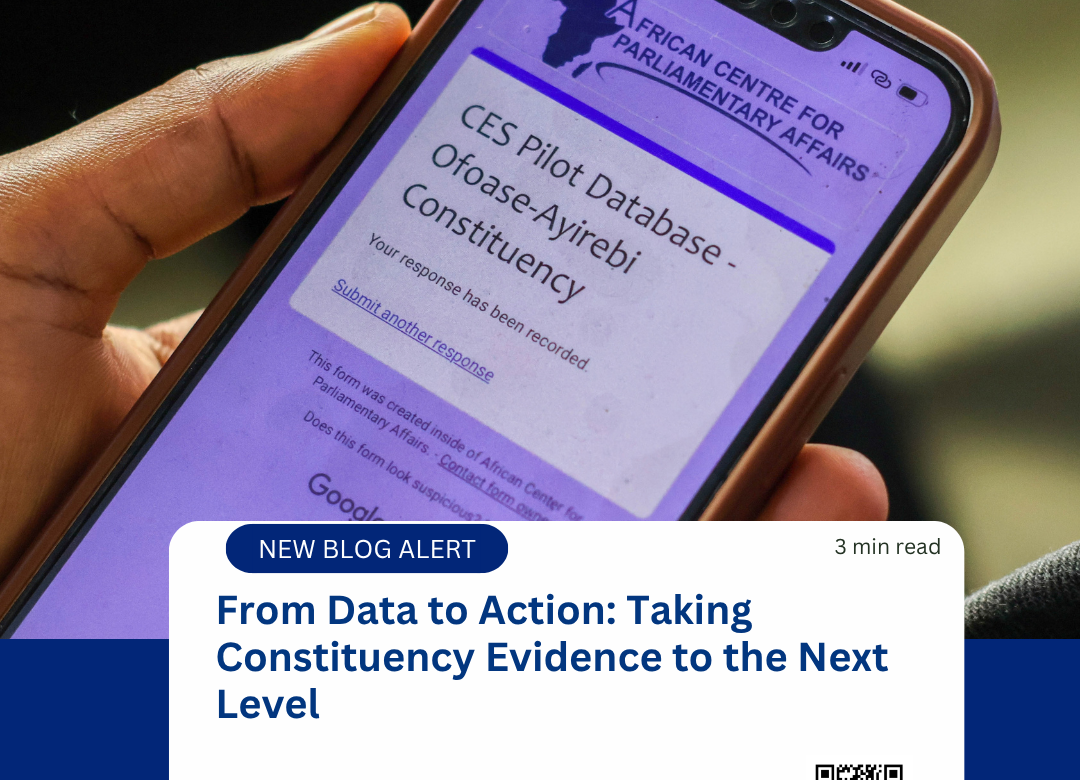
The project’s approach was practical and multi-pronged. It included training MPs and parliamentary staff, supporting the development of constituency profiles that provide MPs with data specific to their communities, establishing an SDG desk within the Parliamentary Research Department, and organizing a data fair that brought data producers and parliament together for conversation.
The results have been tangible. MPs and parliamentary staff now have a greater appreciation for the role of data in decision-making. Mechanisms to help MPs access, interpret, and use SDG data have been developed. Twelve constituency profiles have been produced. Perhaps most significantly, DAP has helped build a growing relationship of trust between Ghana’s Parliament and the Ghana Statistical Service, including the sharing of microdata with Parliamentary Research Officers, something that would have been unthinkable a few years ago.
These achievements are documented in a series of learning pieces and case studies, including insights on data use in parliament, the growing Parliament-GSS relationship, and how Ghana is strengthening parliaments for SDG implementation. A case study on institutionalising evidence use in Ghana’s Parliament further explores how the project navigated COVID-19 and electoral transitions to keep evidence at the centre of parliamentary work.
The lesson from DAP is clear: when parliaments are equipped with the right data and the right capacity to use it, they are better able to hold governments accountable and speak credibly on behalf of citizens.
Inclusive Legislatures: Whose Accountability Are We Talking About?
Data alone, however, is not sufficient. Accountability is only as strong as the voices it represents. If legislatures are dominated by one gender, one class, or one demographic, then the oversight and representation they provide will inevitably be skewed.
This is why inclusive governance is not a side issue; it is central to the question of accountability. When women and marginalized groups are absent from parliamentary processes, their specific needs, experiences, and concerns are less likely to be reflected in laws, budgets, and policies.
The Inclusive Legislatures for Gender-Responsive Policies (ILGRP) Project addresses this challenge head-on. A five-year program funded by Global Affairs Canada and implemented by ACEPA in partnership with the Parliamentary Centre (Canada), ILGRP works across Ghana, Kenya, and Togo to improve the effectiveness of elected officials in advancing inclusive and gender-responsive laws, policies, and budgets. The project began in March 2022. Some of our work on the ILGRP project is documented in a number of pieces, including the Gender Responsive Budgeting in Ghana: An Analysis of the Trade Sector Policy Brief, which speaks to the work we have done in Kenya in supporting the passage of the PWD Bill.
The ILGRP project is driven by a clear ambition to strengthen the capacity of legislatures to formulate gender-responsive institutional strategies, implement administrative reforms for gender-sensitive service delivery, amend and pass inclusive gender laws, including gender-sensitive budgets, and oversee government commitments on gender equality. Crucially, it also works to connect parliaments with citizens, particularly women and girls, so that their voices shape legislative and oversight processes.
Two Projects, One Vision
DAP and ILGRP may focus on different dimensions of parliamentary effectiveness, one on data and evidence, the other on gender and inclusion, but they are united by one conviction: that parliaments can and must do better for the people they serve.
Together, they reflect ACEPA’s holistic approach to parliamentary development. Accountability requires evidence; inclusion requires engagement; and both require sustained, patient institutional capacity building across the governance chain, from national parliaments to local assemblies to civil society and ultimately to citizens.
What Needs to Happen Next
For African legislatures to truly deliver for citizens, several things need to happen concurrently.
First, parliaments need stronger research and analytical capacity. MPs should not have to make decisions in an information vacuum. Dedicated research departments, real-time data access, and strong relationships with national statistical bodies are essential infrastructure for oversight.
Second, gender-responsive governance must move from aspiration to practice. Passing gender equality legislation is one step; ensuring that budgets, policies, and oversight mechanisms reflect the realities of women and marginalized groups requires sustained institutional commitment.
Third, civil society must be seen as a partner, not a threat. The most effective legislatures in Africa are those that maintain open, structured channels for citizen and CSO engagement, not just during elections, but throughout the lawmaking policy and budget cycles.
Finally, the lessons learned from projects like DAP and ILGRP must be shared widely. What works in Ghana’s Parliament or Kenya’s National Assembly may offer valuable models for legislatures across the continent.
Conclusion
The question “Are citizens getting what they need from African legislatures?” does not have a comfortable answer. Yet it remains the right question to keep asking, because only by asking it can parliaments be pushed to serve their people better. And the work being done by ACEPA, through projects like the Data for Accountability Project and the Inclusive Legislatures for Gender-Responsive Policies project, shows that meaningful change is possible when parliaments commit to evidence, inclusion, and genuine citizen engagement.