By: Ubeidat Alhassan, EPL Fellow, ACEPA
A seat at the table. That is what many young people are always told they need. You have probably heard it before: “Wait until you get into power. Get elected, get appointed, be in the place of power; then you can change things.”As if young people have to sit around waiting for a seat at the table before anyone listens.
When we think about influencing policy, we often imagine lawmakers, ministers, and elected officials gathered in formal decision-making spaces. Rarely do we picture young people in these spaces. And why do we accept that only people sitting in parliament get to shape what happens in this country?
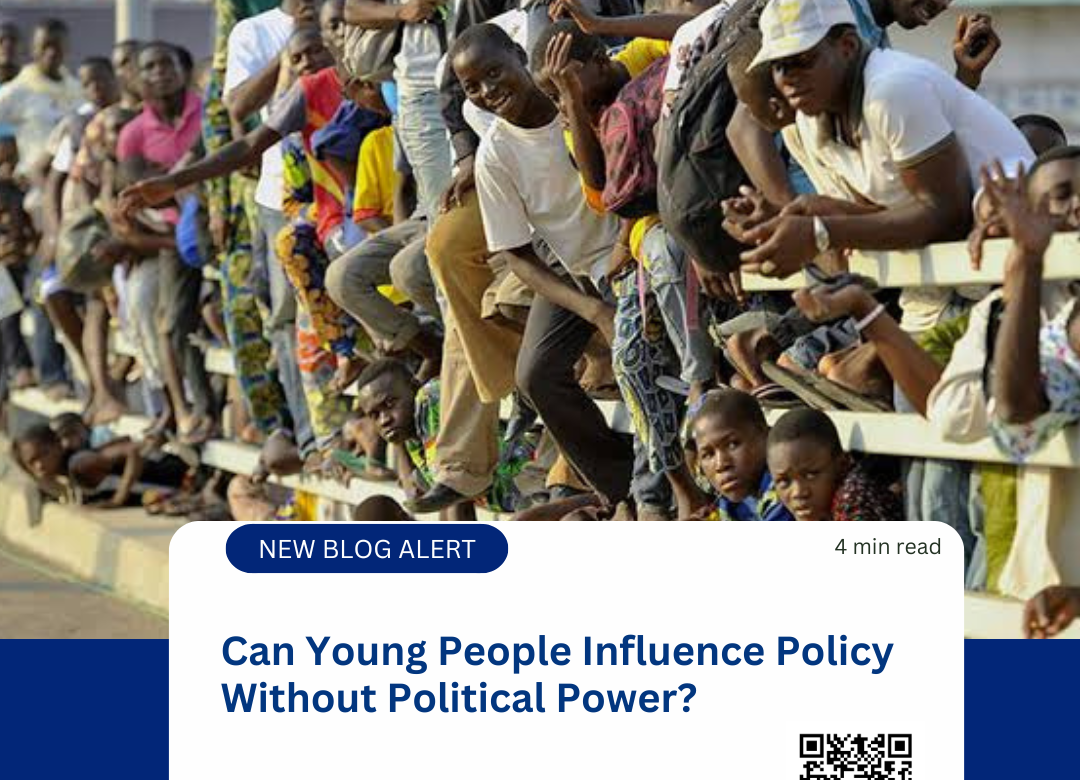
The key questions are: Who sets the rules? Who decides who is included? And who pushes from outside until decision‑makers have no choice but to listen? The simple truth is that young people are the majority[1] in Ghana.
We are not the minority waiting for permission. We are the ones with the numbers, the energy, and increasingly, the power to say “enough is enough” and force things to change.
Defining the Terms
According to the Cambridge Dictionary, Political power is often defined as the ability to influence, shape policy, and control decision-making within a state. In its formal sense, it means holding office. It means being a Member of Parliament, a minister, or a president. It means having a vote in a chamber, a signature on a bill.
Influence, however, is something else entirely. According to the Cambridge Dictionary, influence is the power to affect, sway, or change the behavior, beliefs, opinions, or development of people or things.
Influence, in this case, is the ability to sway what decision-makers think, prioritise, and do, ultimately affecting policy changes, whether directly or indirectly.
The term “young people” or “youth,” according to the Ghana Statistical Service (GSS), refers to individuals between the ages of 15 and 35 years. The National Democratic Congress (NDC) defines a youth member as any party member between the ages of 18 and 40 who belongs to the party’s youth wing. Similarly, the New Patriotic Party (NPP) of Ghana defines young people (the youth) in its party constitution as any member who has not attained the age of 40 years.
The youth can influence policy through channels beyond formal political office. The youth shape what gets attention. This happens through Social media advocacy, Public campaigns, Community mobilization and organization, and so many other forms.
With Evidence and Lived Reality
In 2020, Nigerian youth launched #EndSARS, a leaderless, decentralized movement with no political party, no elected officials, and no formal political power whatsoever. Within days, they compelled the disbandment of a notorious police unit that had terrorized citizens for years. One of the continent’s most powerful governments was forced to respond directly to the demands of young people mobilizing participants online and in the streets. The response, however, was also marked by brutal crackdowns and deadly violence against protesters, underscoring both the risks young activists faced and the profound impact of their mobilization.
In Ghana, the #FixTheCountry movement, which originated in May 2021 as a digital protest on X(formerly Twitter) by the youth, driven by anger over economic hardship and poor social conditions, quickly evolved into a non-partisan offline movement bringing thousands of young Ghanaians into the streets to pressure the government to improve their lives. Again, no political party was involved. No MPs leading the charge. Just young people with phones, conviction, and a community of amplified voices.
The movement shifted the agenda. It forced national conversations and an online campaign for an updated 1992 Constitution of Ghana. It led to the organised #OccupySaglemi to pressure the government to save the abandoned Saglemi Housing Project, and #OccupyJulorbiHouse, which encouraged the president to make Jubilee House not just an office but his official residence. This movement has finally, in 2025, constituted a high-level Constitutional Review Committee to review Ghana’s 1992 Constitution.
In Kenya, the story went further. In 2024, young Kenyans used the same toolkit, digital coordination via X, TikTok, and Instagram, combined with massive street protests, to force their government to withdraw a controversial Finance Bill entirely. The government had no choice but to abandon the legislation entirely. The bill intended to raise KES 3.7 trillion in taxes was scrapped.
This matters because it shows young people do not just set agendas or force meetings. When they organize collectively, they can reverse government policy decisions.
The “Gen Zs” of Madagascar initiated an unprecedented protest, something never done in the world; utilizing Discord and TikTok to topple the government, successfully forcing the resignation and exile of President Andry Rajoelina, initiating a military-led transition. All due to failing public services, corruption, and economic inequality.
On the global stage, Greta Thunberg was a 15-year-old girl sitting outside the Swedish parliament with a handmade sign. She held no office. She had no vote. Today, her movement has influenced the climate commitments of over 100 governments worldwide.
These are not anomalies. These are a pattern. And the pattern says when young people organise, the powerful listen.
Policymakers need to understand that youth influence is already shaping outcomes. Young people are increasingly driving that shift. That is still a real influence.
The Limitations
The real sustained policy change requires being inside the system. There has to be an acknowledgement that the youth have limited access to formal decision-making spaces.
There is also the issue of tokenistic youth engagement and the lack of institutional pathways for young people to meaningfully express themselves. Influence without access remains fragile. This also suggests that what happens within the system is often shaped by pressure from outside it. Policymakers do not operate in isolation; more often than not, they respond to public pressure.
Collective Power in Contributing to Policy Recommendations
There are very clear, documented pathways through which young people influence policy without holding power:
- Civil society organisations that submit policy briefs and sit on technical committees.
- Research and data advocacy: young researchers whose evidence gets cited in national budgets and development plans.
- Digital accountability: leveraging technology where a single viral video of government failure creates more pressure than years of parliamentary debate.
- Using storytelling mechanisms to advise and influence policymakers, and
- Coalition-building with institutions like the ACEPA’s Kampus Konnect, the African Union, and platforms like the Black Star Summit, the Democracy Hub, and youth councils and government advisory boards that create structured access where elections cannot.
These are not consolation prizes for young people who could not get elected. These are legitimate, effective levers of policy influence.
What This Means for Institutions & Policymakers
Movements like #FixTheCountry and #OccupySaglemi helped bring cost-of-living issues to the forefront. It amplified calls for the repeal of certain taxes and stimulated public debate on economic management. It helped create a culture of questioning among the youth, forcing political leadership to respond to online pressure.
If young people are influencing policy outside formal channels, then institutions are confronted with a critical choice: either ignore these voices and risk being overtaken by movements beyond their control, or intentionally create structured pathways through which youth influence can be meaningfully integrated into policymaking.
The argument is not “let young people in because they are right.” Rather, it is “take youth influence seriously because they are already shaping outcomes.”
The Next Level
No politician can govern without citizens.
No party can win without voters.
No economy can thrive without the energy and creativity of its people.
Politics exists because there are people to be governed, and in Ghana, young people make up nearly two‑thirds of the population. That makes youth the majority voice in our democracy.
Do the majority need permission from the minority to be heard? Absolutely not.
When young people act together, as voters shaping elections, as consumers influencing markets, and as citizens deciding which narratives gain attention, they demonstrate real, measurable influence. This influence does not depend on holding a parliamentary seat. It comes from participation, unity, and the ability to set the agenda for the future
Conclusion
Some may argue that influence without political office is only a dream. Yet history shows otherwise. Young people have never waited quietly for permission. They have spoken, organized, and acted until leaders had no choice but to listen.
So, can youth really shape policy without holding formal power? The answer is already clear: they can, and they do, every day.
Young people may not always sit in parliament, but they hold something equally powerful: a collective voice, social influence, and the ability to shape the environment in which decisions are made. Institutions that recognize this should build structures that make youth influence permanent rather than temporary.
For policymakers, the real question is not whether youth will exert pressure from outside. It is why they would wait for that pressure instead of designing systems that welcome youth voices from the start.
Power is not only found in offices. Influence does not always come from titles. Young people will continue to shape policy. The choice for leaders is simple: will they help guide that influence, or will they be forced to respond to it?
[1] According to the Ghana Statistical Service (GSS), Ghana’s population is projected at 34.4 million in 2026, growing at an annual rate of 2.1 percent. Our population remains predominantly youthful, with 12.6 million people aged 15 to 35. This demographic fact underscores why youth voices are central to governance and parliamentary engagement. Angelina Osei Kodua-Nyanor, “Statement at the 59th Session of the Commission on Population and Development (CPD59),” Permanent Mission of Ghana to the United Nations, New York, 13 April 2026, https://www.ghanamissionun.org/04132026/