
Overview
The FoRBLN is implemented by a three-tier consortium and seeks to create a leadership network involving parliamentarians and belief leaders across eight countries to address the legislative barriers to freedom of religion or belief (FoRB) and the social mores that support societal hostility towards minority groups on account of their religion or belief. This leadership will be informed by research on both barrier-crossing leadership in the eight states and an understanding of the likelihood these fragile states will descend into conflict. The overall aim of FoRBLN is to see an increase in the number of people understanding and accessing their right to freedom of religion or belief by reducing the levels of state discrimination against and societal hostility towards individuals on the grounds of their religion or belief. The consortium is led by the Centre for the Study of Social Cohesion, School of Anthropology and Museum Ethnography, University of Oxford (Tier 1). The Church of England is the second-tier partner and ACEPA one of the tier-3 partners on the project.
Interventions
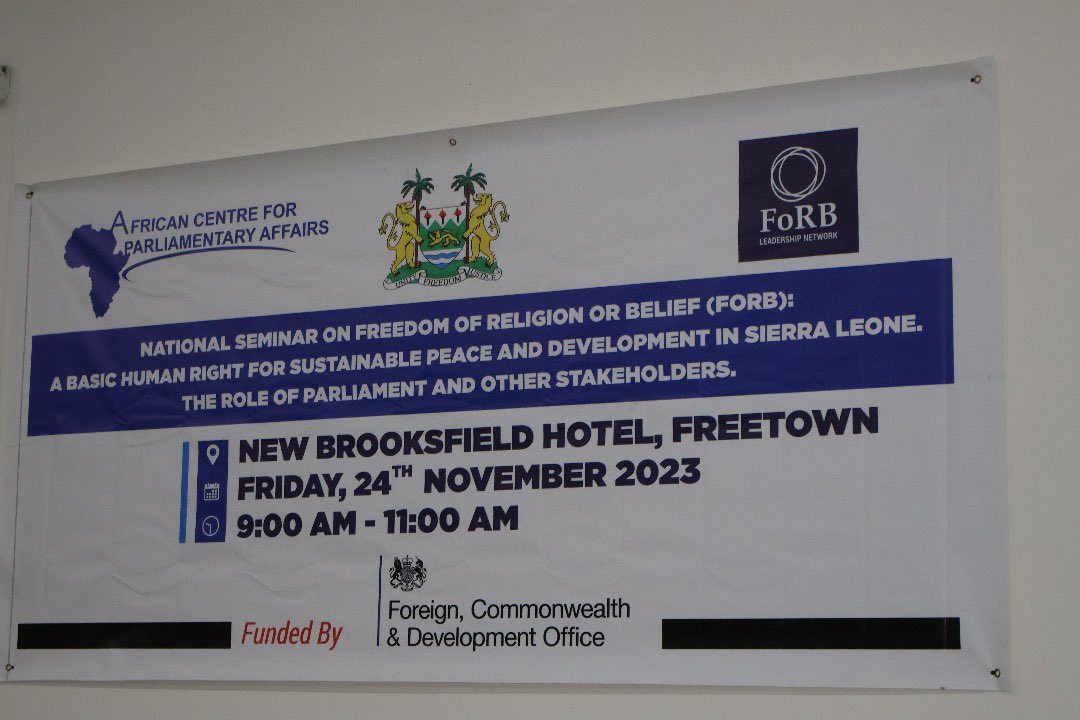
In collaboration with other consortium members, ACEPA is leading the creation of parliamentary caucuses on FoRB and associated stakeholder groups of belief leaders in two of the 8 project countries namely Sierra Leone and The Gambia, that meet on a regular basis to identify the challenges to FoRB in their respective contexts and to develop locally owned responses. The consortium will resource, equip, and place each caucus into a comparative framework to take forward its own programme of work. This strand of work is for the period July 2022 to October 2023.
Outcomes
Parliamentary caucuses on FoRB have been established in the Parliaments of Sierra Leone and The Gambia respectively. A number of national level and local level sensitisation and awareness creation activities, led by MPs, have taken place in the various countries all aimed at advocating FoRB issues.
Partners
- Parliament of Sierra Leone
- National Assembly of the Gambia
- Centre for the Study of Social Cohesion, School of Anthropology and Museum Ethnography, University of Oxford
- The Church of England